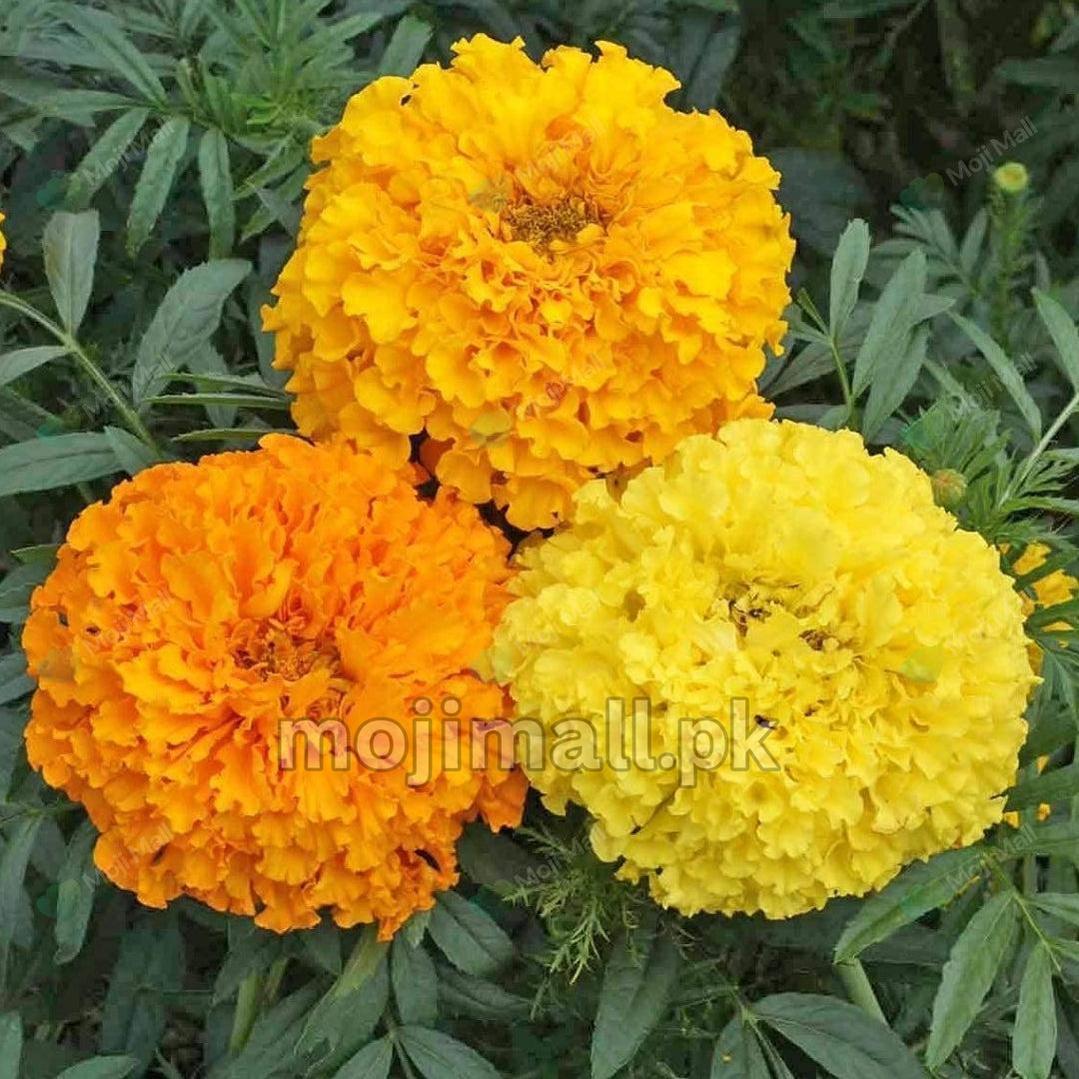
Marigold Mix produces tall, bushy plants with large, rounded flowers in lemon yellow, golden yellow and deep orange. The densely layered blooms stand above finely divided green leaves, creating a bold display in large pots, sunny flower beds and entrance planting.
The long stems make the flowers suitable for garlands, vases and home decoration. This African Marigold type grows quickly in suitable weather and continues developing new buds when old flowers are removed regularly.
Why Grow It
- Large, rounded flowers with densely layered petals
- Includes yellow, gold and orange shades
- Tall plants create height in flower beds
- Suitable for large pots and home garden borders
- Long stems can be used in garlands and vases
- Flowers over an extended period with regular care
Growing Guide
| Detail |
Recommendation |
| Best sowing time |
September to December or late January–March |
| Germination time |
Usually 5–10 days |
| Germination temperature |
Approximately 21–27°C |
| Sowing depth |
Approximately 0.5 cm |
| Sunlight |
6–8 hours of direct sunlight |
| Plant spacing |
Approximately 12–18 inches |
| Pot size |
One plant in a 12–14 inch pot |
| Mature height |
Commonly 24–36 inches |
| Flower size |
Approximately 3–5 inches |
| First flowers |
Usually 10–13 weeks after sowing |
Best Time
Marigold Mix grows best when days are sunny and temperatures are mild to warm. In most areas of Pakistan, sow from September to December for autumn and winter flowering. A second sowing can be made from late January to March for spring flowers.
In Lahore and Faisalabad, sow from late August to October after heavy monsoon rain has eased, or from late January to March. In Islamabad and Rawalpindi, sow from August to September or from February to April after the coldest nights have passed.
In hotter areas such as Karachi and southern Punjab, sow from September to February after the strongest summer heat has eased. In colder northern and hilly areas, sow from March to May after the risk of hard frost has passed.
How to Sow
- Fill a seedling tray or small pots with a fine, moist seed-starting mixture.
- Sow the long seeds approximately 0.5 cm deep and cover them lightly.
- Water gently using a fine spray.
- Keep the mixture warm and lightly moist until germination.
- Transplant seedlings after they develop 2–3 pairs of true leaves.
Leave approximately 12–18 inches between plants. Handle seedlings by their leaves or surrounding soil instead of pulling them by the stem.
Best Soil
Use moderately fertile soil that drains easily. Marigolds can develop weak roots and fungal problems when their soil remains constantly wet.
Mix garden soil with a suitable potting medium to improve drainage. A small amount of vermicompost can be added before transplanting.
For container growing, use one plant in each 12–14 inch pot. Make sure the pot has open drainage holes and enough weight to support the tall plant.
Plant Care
- Provide at least 6 hours of direct sunlight.
- Water regularly while young plants are becoming established.
- Allow the upper soil layer to begin drying before watering again.
- Apply water around the soil instead of repeatedly wetting the flowers.
- Pinch the main growing tip when the plant is 6–8 inches tall.
- Support tall stems in exposed or windy locations.
- Remove faded flowers before they begin forming seeds.
- Keep enough space between plants for airflow.
- Check tender growth and leaf undersides for pests.
- Remove yellow, damaged or badly affected leaves.
Pinching the main tip encourages the plant to form more side branches and flowering stems. Use clean fingers or scissors and make the cut immediately above a healthy pair of leaves.
If aphids, spider mites or thrips appear, apply Neem Oil according to its directions. Avoid spraying open flowers and do not apply during strong sunlight.
Feeding
Marigolds usually need moderate feeding. Excessive fertilizer, especially nitrogen-heavy fertilizer, can produce tall leafy growth with fewer flowers.
Before transplanting, mix a small amount of vermicompost into the soil. Once flower buds begin forming, mix 1 teaspoon of Flowers Fertilizer in 1 litre of water.
Apply the prepared solution around the root area or use it as a light spray. Repeat every 10–15 days if needed. Reduce or pause feeding during extreme heat, prolonged rain or severe plant stress.
Flowering
Plants commonly begin flowering approximately 10–13 weeks after sowing. The exact timing depends on temperature, sunlight, plant health and when the seedlings were transplanted.
Remove faded flower heads before seeds develop to encourage additional buds. Cut the stem just above a healthy leafy branch instead of leaving a long bare section.
For garlands or indoor arrangements, pick flowers after they have opened fully but before the outer petals begin fading. Cut during the cooler morning or evening hours and place the stems in clean water.
Local Tips
- Use a heavy pot so tall plants do not fall over easily.
- Add a stake before the stems become crowded with flowers.
- Sow another small batch after 3–4 weeks for later flowering.
- Keep container plants where they receive sunlight from more than one direction.
- Remove fallen petals and damaged leaves from the soil surface.
- Check drainage after heavy rain, especially in rooftop pots.
FAQs
Is Marigold the same as Calendula?
No. This Marigold belongs to Tagetes erecta, while Calendula belongs to Calendula officinalis. They have different leaves, plant shapes and flower structures.
Can I save seeds from Marigold Mix?
Yes. Leave a few healthy flower heads on the plant until they become brown and completely dry. Remove the long seeds and store them in a labelled paper envelope. Plants grown from saved seeds may differ slightly in height, colour or flower shape.
Does Marigold keep every garden pest away?
No. Marigolds do not protect an entire garden from every insect. Some types may help with particular soil problems when planted correctly, but regular checking and suitable pest control are still necessary.
Why are the flower buds turning brown before opening?
Prolonged rain, repeatedly wet flowers, poor airflow or fungal infection can damage unopened buds. Remove affected buds, improve spacing and water around the soil instead of over the plant.
Will one plant produce every colour in the mix?
Not necessarily. Each seed develops into an individual plant with its own flower colour. Grow several seeds if you want a better chance of getting yellow, gold and orange flowers from the packet.
Common Names: Marigold Mix, Giant Marigold, African Marigold, Aztec Marigold, Genda, Genda Phool, Gainda (گیندا)