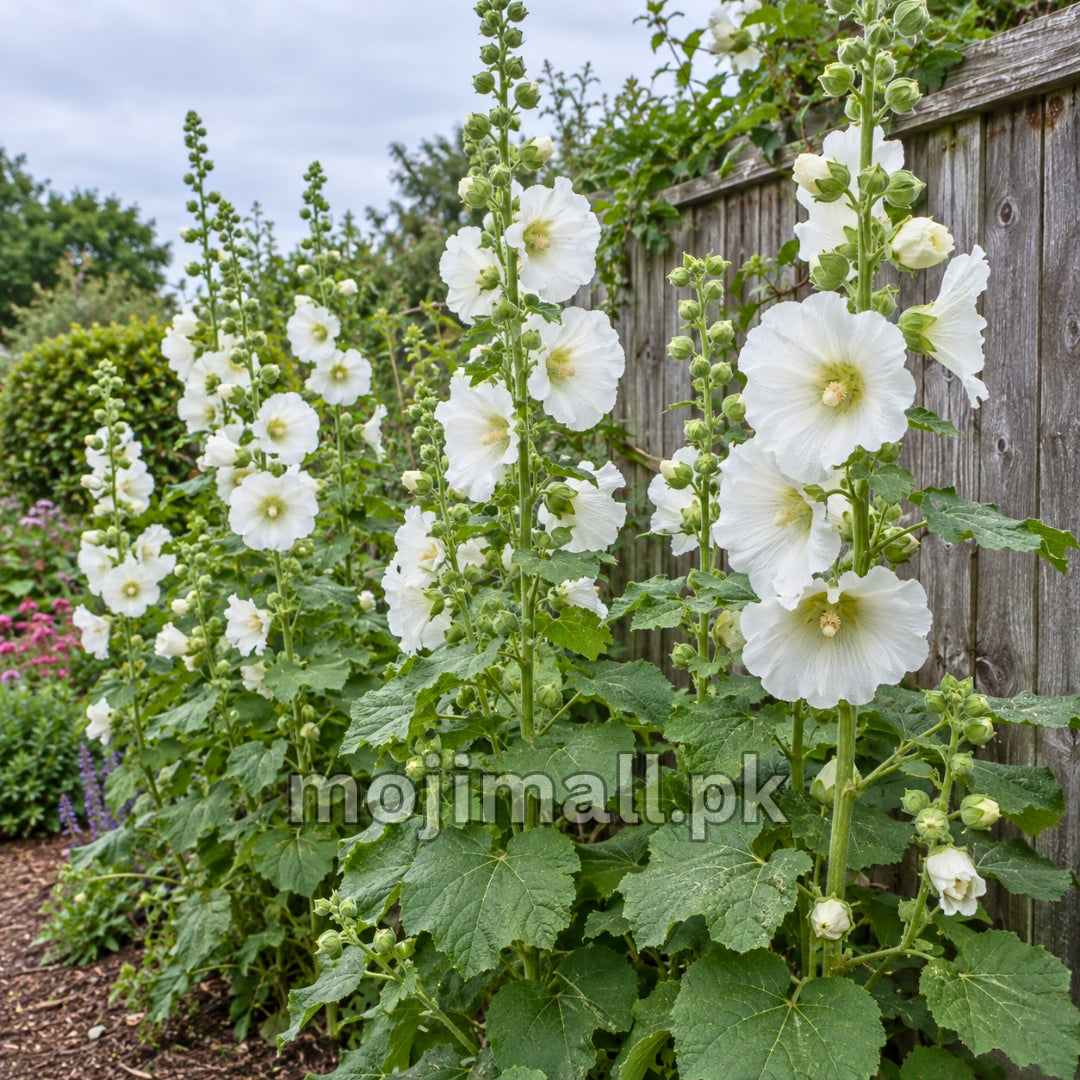
White Hollyhock begins as a broad cluster of textured green leaves, then sends up tall stems carrying large, bowl-shaped white flowers. The softly ruffled petals and pale centres stand out clearly against green plants, brick walls and darker garden backgrounds.
This upright flower is best placed beside sunny walls, gates and fences or towards the back of a flower bed. Hollyhock has been grown in gardens for centuries and is linked botanically to Türkiye and western Asia. It develops through cool weather and raises its flowering spikes as conditions become milder.
Why Grow It
-
White Flowers: Large pale blooms brighten darker garden corners.
-
Vertical Shape: Tall spikes use narrow spaces without spreading widely.
-
Open Blooms: Visible centres make the flowers easy for bees to visit.
-
Gradual Display: New flowers continue opening higher along each stem.
Best Conditions
-
Germination: Usually 10–21 days
-
Temperature: Around 18–24°C
-
Sunlight: At least 6 hours
-
Pot size: 12–18-inch-wide and deep pot
-
Spacing: About 18–24 inches between plants
-
Plant height: Usually around 5–7 feet
-
Flower size: Approximately 3–5 inches
-
Soil: Fertile, moisture-retaining and well-draining mix
In Lahore and Faisalabad, sow from September to November. In Islamabad and Rawalpindi, sow from September to October with protection during severe frost, or again from late February to March. In hotter areas such as Karachi and southern Punjab, sow from October to December after the strongest summer heat has eased. In colder northern and hilly areas, sow from March to April after the risk of hard frost has passed.
How to Sow
Hollyhock forms a long main root while young, so direct sowing or individual starter pots are better than a crowded tray.
- Prepare the final bed or fill individual pots with fine, moist soil.
- Place one or two seeds at each planting position.
- Cover the seeds with around ⅛ inch of fine soil.
- Water the area gently using a fine spray.
- Keep the soil lightly moist until seedlings appear.
- At 3–4 true leaves, keep the strongest plant at each position.
Plant Care
Keep the soil evenly moist while the plant is developing its leafy base. Once established, water deeply when the upper soil begins to dry. Apply water near the base so the large leaves remain dry.
Mix a small amount of Vermicompost into the soil before planting. Potted plants can receive another light top-dressing when the flower stalk begins forming. Avoid heavy feeding because soft stems bend more easily.
Tie the rising flower stalk loosely to a stake or fence before it becomes top-heavy. Check the lower leaves regularly for Hollyhock rust, which appears as yellow marks above and brown powdery spots underneath. Remove affected leaves and clear fallen material.
If aphids or spider mites gather on the plant, spray Neem Oil on the affected foliage while avoiding open flowers.
Local Gardener Tips
- Use a brick wall or dark green plants to highlight the white blooms.
- Grow only one plant in each large container.
- Leave a gap beside walls so air can move around the leaves.
- Shelter potted plants from strong winds on open rooftops.
Flowering
The plant may spend its early months forming a wide cluster of leaves. An autumn-sown plant that matures quickly may flower from late spring into early summer. Some standard Hollyhocks behave as biennials and bloom during the following suitable season.
Flowers open in sequence from the lower part of the stalk towards the top. Remove wilted white blooms promptly to keep the spike looking clean. Cut the stalk near its base after the final buds have finished.
FAQs
Why are the white petals developing brown edges?
Individual flowers naturally begin browning as they age. Heavy rain, overhead watering and strong heat can make this happen sooner. Remove faded flowers and water near the soil.
Is White Hollyhock the same as White Hibiscus?
No. They belong to the same plant family but are different plants. Hollyhock produces a tall spike lined with flowers, while Hibiscus usually grows as a branching shrub.
Common names: White Hollyhock, Single White Hollyhock, Gul Khaira, گل خیرا