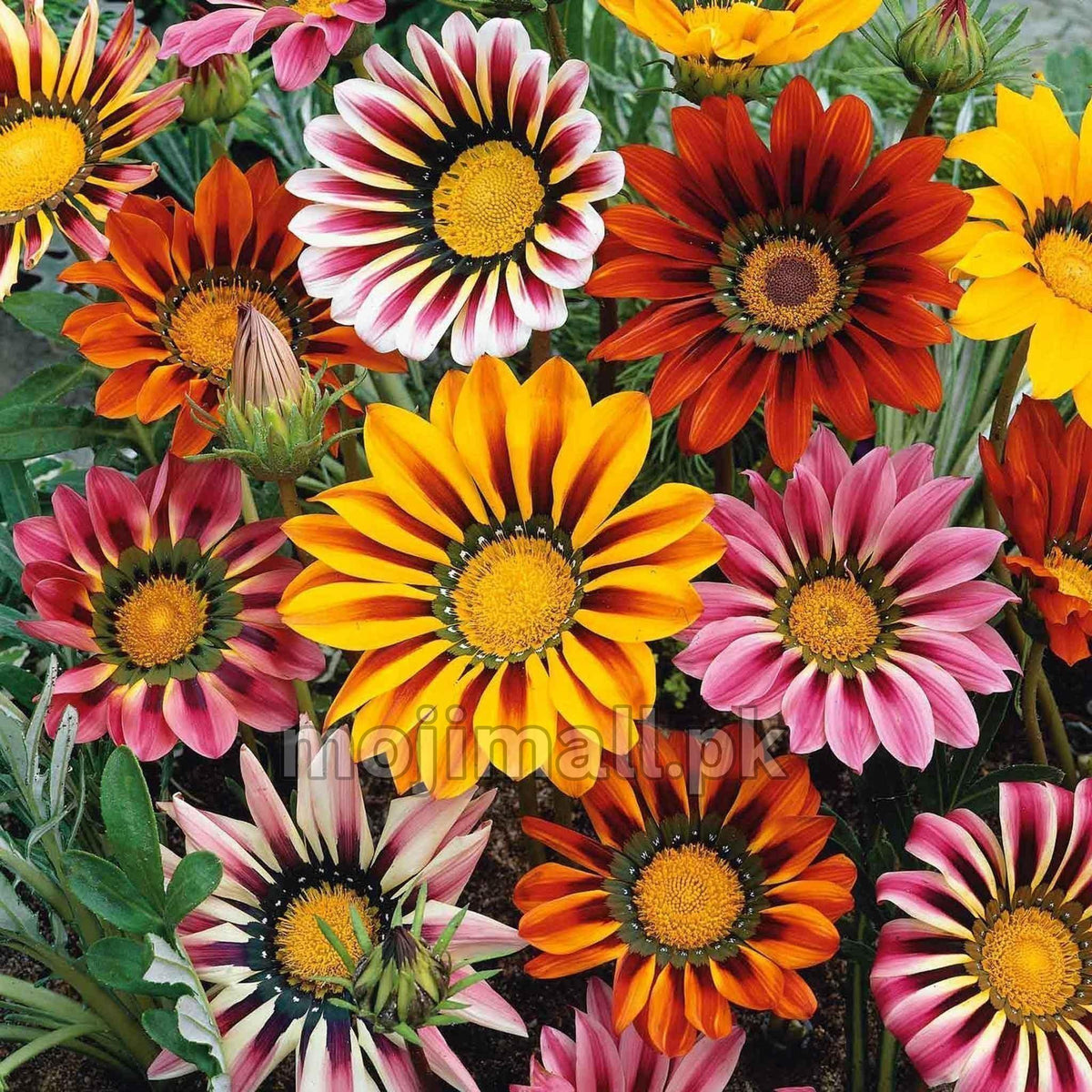
Gazania flower seeds grow into compact, spreading plants with large, daisy-like blooms. Gazania Mix may produce yellow, orange, red, pink and white flowers with dark rings, striped petals or contrasting centres.
These sun-loving flowers are suitable for pots, pathway edges, rock gardens and the front of sunny garden beds. Established plants tolerate brief dry periods and perform best where the soil drains quickly.
Why Grow It
- Large flowers in mixed colours and patterns
- Compact and gently spreading growth
- Suitable for sunny pots and borders
- Tolerates brief dryness once established
- Useful for pathway edges and rock gardens
- Performs well in bright winter and spring weather
- Gazania seeds with a high germination rate, tested for germination
Growing Guide
| Detail |
Recommendation |
| Best sowing time |
September to November |
| Hotter areas |
October to December |
| Colder areas |
March to April after frost risk has passed |
| Germination time |
Usually 7–14 days |
| Germination temperature |
Approximately 20–24°C |
| Sowing depth |
Approximately 0.3 cm |
| Sunlight |
At least 6 hours of direct sunlight |
| Pot size |
An 8–12 inch pot for one plant |
| Plant spacing |
Approximately 8–10 inches |
| Mature height |
Commonly 6–12 inches |
| Flower size |
Approximately 2–4 inches |
| Flowering time |
Usually 12–16 weeks after sowing |
Best Time
Gazania grows best during cool to moderately warm, sunny weather. In most areas of Pakistan, sow from September to November for flowering from late winter into spring.
In Lahore and Faisalabad, sow from September to November or again from late January to February. In Islamabad and Rawalpindi, sow from September to October with protection during severe frost, or from late February to March.
In hotter areas such as Karachi and southern Punjab, sow from October to December after the strongest summer heat has eased. In colder northern and hilly areas, sow from March to April after the danger of hard frost has passed.
How to Sow
- Fill a seedling tray or small pots with a fine, lightly moist seed-starting mixture.
- Place one seed in each cell or spread the seeds thinly over the surface.
- Cover them with approximately 0.3 cm of fine mixture.
- Mist gently and keep the container warm and lightly moist.
- Transplant seedlings when they have 2–3 pairs of true leaves, leaving 8–10 inches between plants.
Seeds usually germinate within 7–14 days under suitable conditions. Avoid covering them deeply or leaving the mixture constantly soaked.
Pot and Soil
Grow one plant in an 8–12 inch pot. Several plants can be placed in a wider container when each one has enough space for its leaves and roots.
Gazania needs light soil that drains quickly. Combine garden soil with a suitable potting medium to improve drainage and airflow.
A small amount of vermicompost may be added before transplanting. Avoid an excessively rich mixture because heavy feeding can encourage leaves instead of flowers.
Plant Care
- Provide at least 6 hours of direct sunlight.
- Water regularly while seedlings are becoming established.
- Allow the upper soil layer to begin drying between later waterings.
- Apply water around the soil instead of soaking the flowers.
- Keep pots raised during rainy weather.
- Remove faded flowers regularly.
- Protect young seedlings from severe frost.
- Avoid excessive nitrogen fertilizer.
- Check new growth and leaf undersides for pests.
If established plants need feeding during budding, mix 1 teaspoon of Flowers Fertilizer in 1 litre of water. Apply it around the soil or spray the foliage lightly during the morning or evening. Repeat every 10–15 days if needed.
Aphids, mites and mealybugs may occasionally gather around tender growth. Neem oil can be used according to its directions while avoiding unnecessary spraying over open flowers.
Flowering
Plants commonly begin flowering approximately 12–16 weeks after sowing. Autumn-sown plants generally provide their main display from late winter into spring.
Remove faded blooms by cutting their stems close to the leafy base. This keeps the plant tidy and encourages later buds while the weather remains suitable.
Local Tips
- Choose the brightest available location for fuller flowering.
- Introduce young seedlings to direct sunlight gradually.
- Protect seed trays from strong watering and prolonged rain.
- Use wider containers when growing several colours together.
- Raise outdoor pots slightly so rainwater can leave freely.
- Do not allow young seedlings to dry completely.
- Provide light afternoon protection during periods of extreme heat.
FAQs
Why do Gazania flowers close during cloudy weather?
This is a natural feature of Gazania. The flowers open fully in bright sunlight and may close at night, in shade or when the weather remains cloudy.
Will one Gazania plant produce every colour in the mix?
No. Each seed normally develops into one plant with its own flower colour or pattern. Grow several seeds for a wider mixed-colour display.
Can Gazania survive for more than one season?
Gazania is a tender perennial and may survive in warm, frost-free areas with excellent drainage. Hard frost and prolonged wet weather can kill it, so it is commonly grown as a seasonal flower in Pakistan.
Can I collect Gazania seeds?
Yes. Leave selected flower heads until they become completely dry. Collect the seeds before the wind carries them away. Plants grown from saved seeds may produce different colours or patterns.
Common Names: Gazania Mix, Gazania, Treasure Flower, Gazania rigens, Gazania splendens