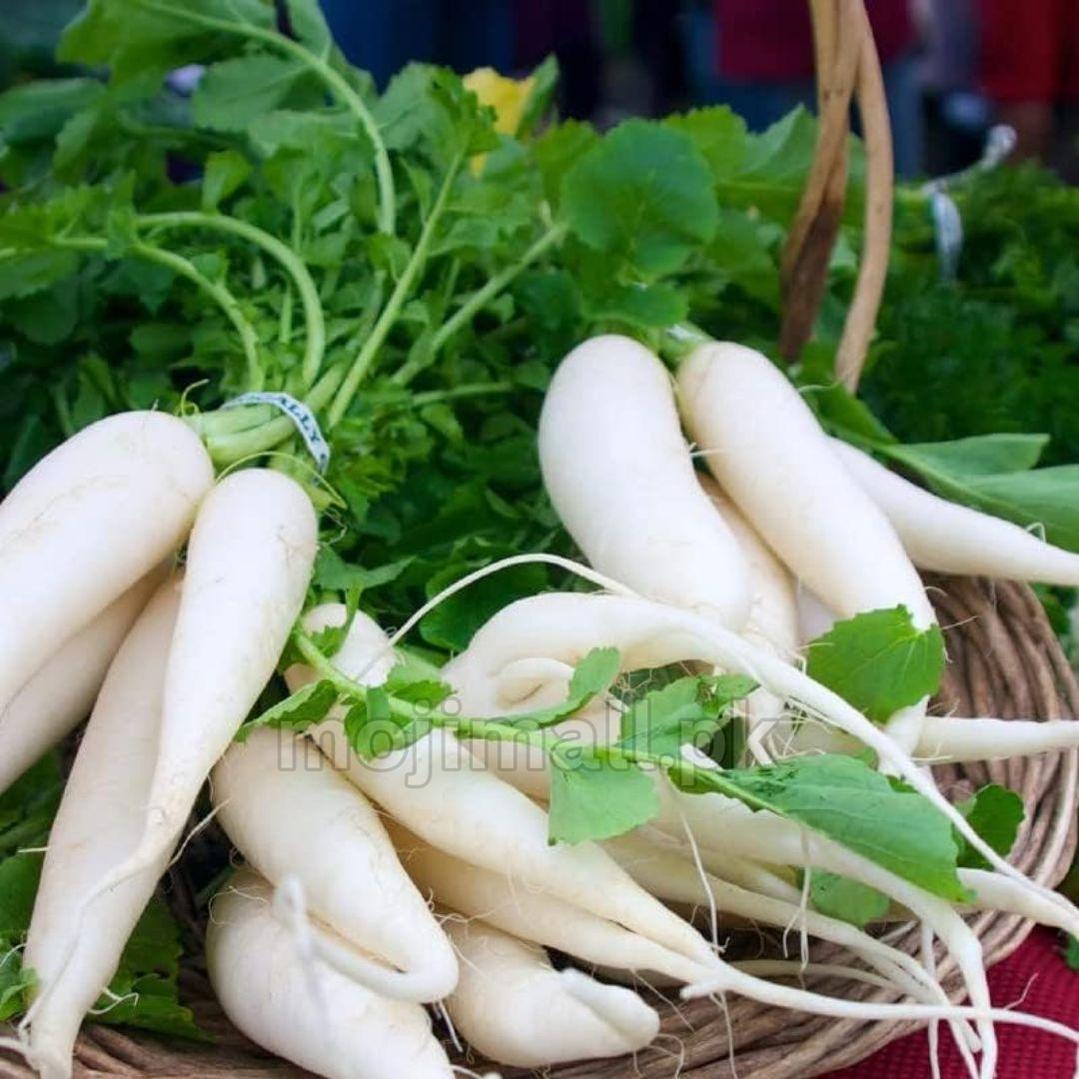
Desi White Radish, commonly called mooli, is a cool-season vegetable with long white roots and leafy green tops. Fresh mooli is crisp, juicy and pleasantly sharp. It can be eaten with salt and lemon, added to salads and raita, stuffed into parathas, cooked as sabzi or preserved as achar.
Radish originated in Southeast Asia and later spread across South, Central and East Asia, where different long white forms were developed. Desi mooli has long been grown in Pakistan as a familiar winter vegetable for its crisp roots and edible leaves.
Why Grow It
-
Flavour: Crisp roots with the fresh, sharp taste associated with traditional mooli.
-
Local Uses: Suitable for parathas, salads, raita, sabzi and achar.
-
Edible Leaves: Young leaves can be cooked in saag, bhujia and stuffed breads.
-
Quick Results: Roots can be ready within a few weeks during cool weather.
-
Container Friendly: Suitable for deep pots and grow bags with enough soil depth.
Best Conditions
-
Germination: Usually 3–7 days
-
Temperature: Around 10–20°C
-
Sunlight: At least 6 hours
-
Pot size: A 12–14-inch-deep pot or grow bag
-
Spacing: About 3–4 inches between plants
-
Plant height: Usually around 12–18 inches
-
Soil: Loose, stone-free and well-draining soil
In Lahore, Faisalabad, Islamabad and Rawalpindi, sow from September to February. In hotter areas such as Karachi and southern Punjab, sow from October to February, after the strongest heat has passed. In colder northern and hilly areas, sow from March to April after severe frost, or from August to September for an autumn planting.
How to Sow
- Loosen the soil to a depth of at least 12 inches and remove stones, old roots and hard clumps.
- Sow the seeds directly about ½ inch deep, leaving roughly 1 inch between seeds.
- Cover with fine soil and water gently without washing the seeds out.
- When the seedlings are around 2 inches tall, cut the weaker ones at soil level, leaving 3–4 inches between plants.
- Keep the soil evenly moist while the white roots are forming.
Plant Care
Water regularly so the soil remains lightly moist but never waterlogged. Mooli grows poorly when the soil repeatedly changes from very dry to heavily wet. Remove weeds while they are small, taking care not to disturb the developing roots.
Mix a small amount of Vermicompost into the soil before sowing. If the soil is already fertile, additional feeding is usually unnecessary. Too much fertilizer can produce large leaves while the roots remain thin.
Check the leaves for aphids, especially around curled new growth. Remove badly affected leaves and spray Neem Oil on the remaining affected leaves, including their undersides.
Local Gardener Tips
- Sow directly because transplanting can damage the young root and change its shape.
- Prepare the full soil depth before planting, not only the upper few inches.
- Sow a small new row every 10–14 days instead of planting every seed at once.
- If a mature mooli is difficult to pull, water the soil lightly and wait before trying again.
Harvesting
Begin checking the roots around 25 days after sowing. Move a little soil away from the shoulder of one plant. Harvest when the upper root is about 1–2 inches wide and the mooli has reached a suitable length, usually within 25–40 days.
Hold the leaves close to the root and pull steadily. Loosen the surrounding soil first if the root does not come out easily. Do not leave mature mooli in the soil for too long, as the centre may become fibrous, hollow or spongy.
Wash the roots and cut off the leafy tops before refrigeration. Store the leaves separately and use them soon after harvesting.
FAQs
Why does home-grown mooli taste extremely sharp?
Warm weather, dry soil and delayed harvesting can make the flavour much stronger. Sow during cool weather and harvest while the roots are still firm and juicy.
Why has the plant started flowering without making a good root?
This usually happens when the weather becomes too warm or the plant experiences stress. Once a flower stalk appears, the root quality normally does not improve.
What causes many tiny holes in mooli leaves?
Flea beetles commonly make small round holes in young radish leaves. Fine insect mesh can protect new seedlings, while early treatment helps prevent heavier damage.
Common names: Desi Mooli, White Radish, Garden Radish, Safed Mooli, مولی, سفید مولی