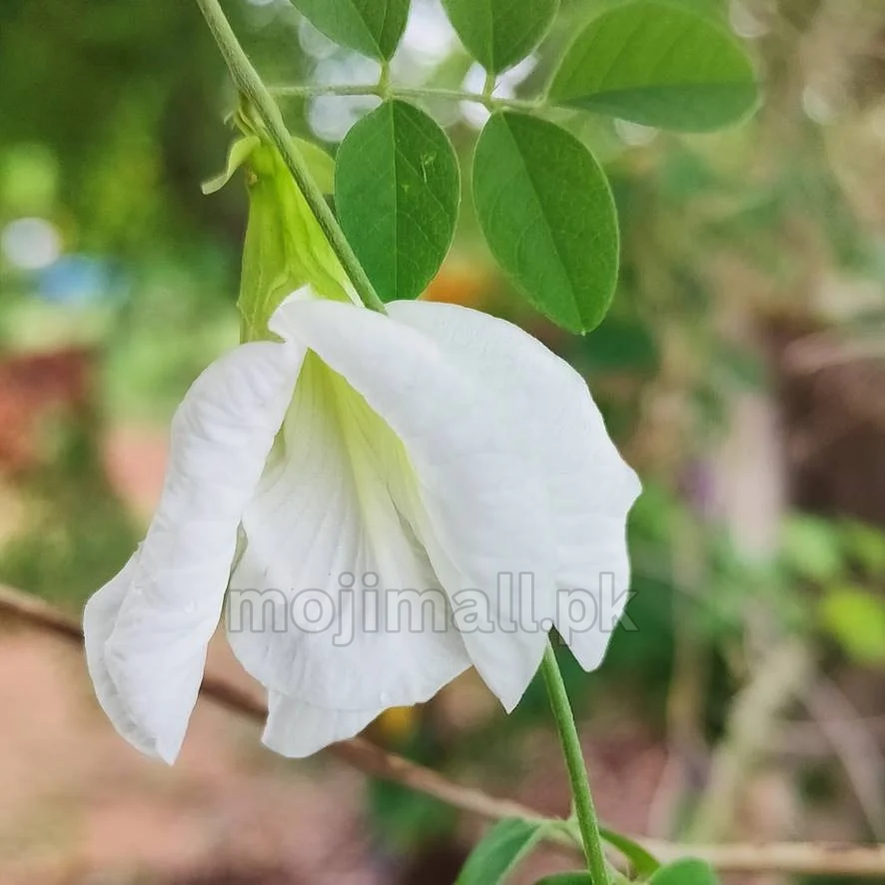
Butterfly Pea Double White is a warm-season climbing vine grown for its layered, double-petal white flowers. Commonly known as Double White Aparajita, its fuller blooms appear among fresh green foliage and give the vine a distinctive ornamental look.
The vine grows well during Pakistan’s spring and monsoon seasons and climbs by twining around balcony grills, fences, arches and trellises. It works especially well on entrance supports, courtyard trellises and other visible garden areas where its unusual flower shape can be appreciated closely.
💐 Growing Guide
-
Sowing
- Soak the seeds in water for 8 to 12 hours, or gently scratch the hard outer coat before sowing.
- Sow about ½ to 1 inch deep in a light, well-draining growing mix.
- Sow directly beside a permanent climbing support or start each seed in a separate small pot.
-
Germination & Transplanting
- Seeds usually germinate within 7 to 14 days in warm conditions, although some may take 2 to 3 weeks.
- Keep the growing mix lightly moist but not waterlogged.
- Once seedlings develop 2 to 3 true leaves, transplant them carefully.
- Keep the soil around the roots intact to reduce transplant stress.
-
Spacing & Container Size
- Space vines about 8 to 12 inches apart along a fence or trellis.
- For one vine, use a container at least 12 to 14 inches wide and 10 to 12 inches deep.
- Choose a larger, heavier pot when growing several vines or attaching a tall support.
-
Sunlight, Support & Watering
- Give the vine plenty of direct sunlight for healthy growth and regular flowering.
- Provide a balcony grill, fence, arch or trellis while the plant is young.
- Guide new stems onto the support as they lengthen.
- Water when the upper layer of soil begins to dry, keeping the root area moist but not soggy.
-
Pruning, Pests & Flower Care
- Pinch the growing tips or lightly trim long stems to encourage more branching.
- Remove dry flowers to keep the vine tidy and support continued blooming.
- Check young leaves and shoots for aphids, mites and other sap-feeding pests.
- Use neem oil only when pests appear.
- Leave selected pods to mature when you want to collect seeds.
Additional Information
Other Names: Double White Butterfly Pea, Double White Aparajita, Double Safed Aparajita, Clitoria ternatea Double White
Best Sowing Time: Sow from February to April in many parts of Punjab and Sindh after cold weather has passed. It may also be sown during the monsoon where rainfall is regular and drainage is good. In cooler northern areas, sow once the soil and nights become warm.
Flower Colour: Clear white, sometimes with a pale cream or light yellow marking near the centre.
Growth Habit: A slender twining vine that climbs grills, fences, arches and trellises with support.
Main Use: Ornamental vertical flowering cover for balconies, entrances, courtyards and home garden trellises.
Life Cycle: A tropical perennial vine that may continue growing for more than one season in warm locations but can be damaged by winter cold.
Frequently Asked Questions
Can Double White Butterfly Pea grow in a pot?
Yes. It grows well in a sufficiently deep container (at least 12 to 14 inches wide and 10 to 12 inches deep) with drainage holes and a firm climbing support. Place the pot in a sunny location and avoid allowing water to collect around the roots.
Why is my Double White Butterfly Pea growing leaves but few flowers?
Too little direct sunlight or frequent use of high-nitrogen fertiliser can encourage leafy growth instead of flowering. Give the vine more sun and lightly trim long shoots to encourage additional flowering branches.
Does Double White Butterfly Pea need climbing support?
Yes. Its stems climb by twining around nearby structures. Provide a grill, fence, arch or trellis early so the vine grows upward instead of spreading across the ground.